
Coping with change as an autistic adult is an ongoing process. Like many other aspects of autism, it’s about self-compassion rather than trying to “fix” the issue.
As autistic adults, we can try to force ourselves to “like” or “cope” with change. Realistically, we’re just pushing down our feelings. It won’t rid us of the struggle, simply mask it to those around us.
If you don’t mask (or your mask slips and you experience a meltdown), neurotypical people can be very judgemental. They may have told you to “just get on with it,” or viewed you as “slow”, “stubborn”, “difficult”, or a “primadonna”. You may even have called yourself these names.
That’s not to say the autistic struggle with change is entirely external. Whether we have support or not, change can be very difficult for autistic people.
In this post, I’ll cover:
- Some of the reasons autistic people struggle with change
- Common challenges with short term change
- Common challenges with long term change
- Why even nice changes can be challenging
- Strategies I use to manage my struggles with change
TLDR: Autism and change infographic
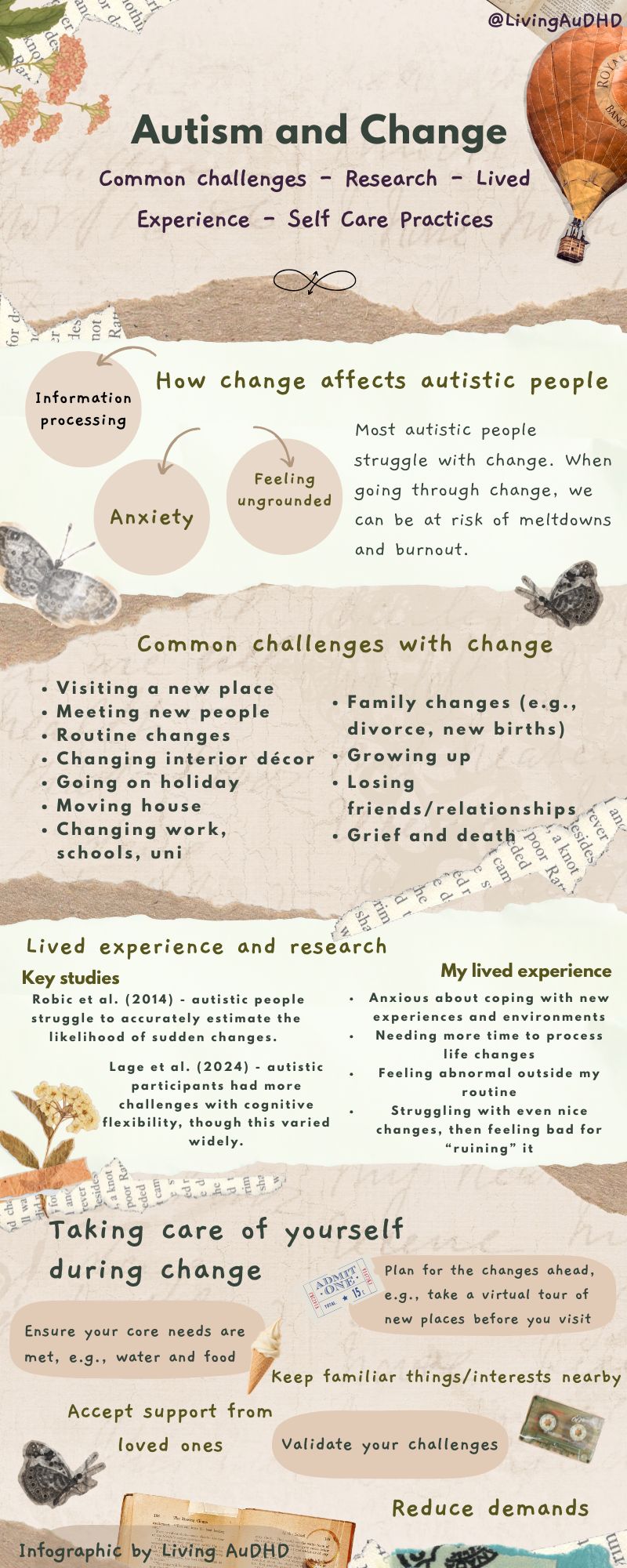
Do autistic adults struggle with change?
Yes, typically autistic adults struggle with change. However, as with everything autism related, it’s a spectrum.
Some autistic adults may struggle far less with change, but they will usually have stronger challenges in other areas.
As a spectrum, autism doesn’t range from “slightly autistic” to “very autistic”. We tend to have “spiky profiles” with strengths in some areas and weaknesses in others. Although we all share a certain set of traits, these vary between each individual.
As the saying goes, “If you’ve met one autistic person, you’ve met one autistic person.”
Our needs can also fluctuate depending on what’s going on in our lives. For example, if I’m unwell or struggling with sensory issues, I’m less likely to cope well with change.
These struggles can be with short and long term change. With short term change, I might struggle with:
- Visiting a new place
- Meeting new people
- Entering a new environment
- Experiencing a change to my routine (expected or unexpected)
- Trying a new activity or task
- Changing or redecorating a room
- Going on holiday
Long term changes I’ve struggled with include:
- Moving house
- Starting and leaving jobs
- Growing up
- Losing friends
Why do autistic people struggle with transitions and change?
There are some theories about why autistic people struggle with change, from both academic research and lived experience accounts. To explore this, I’ll first need to highlight the ongoing conflict between the autistic community and mainstream psychology.
A short disclaimer on autism research and lived experience
Many autistics feel that there is still a fundamental misunderstanding of autism within mainstream autism research. For example, mainstream research often uses the deficit, medicalist model of autism, characterising it as a disorder, rather than an equally valuable neurotype.
So, I’ll explore some of the mainstream research here, but then also go into my own personal experiences to balance this out. I have a Master’s degree in Psychology and have conducted empirical research as part of my dissertation, and so am experienced with analysing research critically.
As mentioned above, autism is a spectrum. My experience relates to other autistic people, but we are all unique.
I don’t believe in functioning labels, as they tend to be reductive and dismissive of the complexity of autistic strengths and challenges. But to give you an impression of where I might stand on the spectrum, and how I might compare to your experiences, I would describe myself as:
- Low support needs overall.
- Particularly struggling with sensory or environmental changes, spontaneous social interactions, and information processing.
- I also have co-occurring ADHD, OCD and Chronic Fatigue Syndrome, which compounds my autistic challenges.
So, onto the research and lived experience!
What does the research say about autism and change?
The research focuses on why autistic people may struggle with short term changes like switching between tasks. This is mostly explored within laboratory experiments, rather than real world scenarios.
Robic et al. (2014)
For example, in Robic et al. (2014), 14 autistic participants (and 15 non-autistic participants) took part in a decision making task. Autistic participants had less success when the criteria was unstable (i.e., it kept changing). Whilst social cues also contributed to reduced success in the autistic group, instability was still the biggest challenge. Autistic participants also continued with a particular decision making pattern for longer than controls, even if it had been disproven.
The researchers argued that autistic people struggle to accurately estimate volatility – the likelihood of circumstances changing suddenly and rapidly. They suggested this could be linked to impairments in the anterior cingulate cortex (ACC) in the brain. This would mean that autistic people struggle to adapt their knowledge of a situation when it changes suddenly, contributing to difficulties with change.
Some points to consider
Half of the autistic participants changed their decision-making correctly based on the cue reliability. This suggests that challenges with processing cues are not consistent in the autistic community, and that the ability level was not linked to AQ (Autism Quotient) results (i.e., participants’ abilities didn’t depend on how many or few autistic traits they had).
The study also involved a small number of participants, which could make it less applicable to the wider autistic population. This means replications of the study with a larger sample size would be useful.
My thoughts as an autistic adult
Whilst the study is interesting, there are a few criticisms that I would make.
Like many autism studies, it doesn’t explore the emotional side of our struggles with change. The study focuses on a non-emotional decision making task in a laboratory setting. I also feel concerned about the inconsistent results, as half the autistic participants did not have issues with changing their decision making processes, and the participant number was already low. How applicable is this study to real world settings?
Also, in my experience, I would say I’m good at predicting volatility, just not at dealing with it. Even when I can see change coming from far away, I feel unequipped to deal with it. I’m slow to process information, and it causes me great fatigue. There’s also the struggle of letting go of things, people and places I’ve become emotionally attached to.
And that’s not just me. Autistic people can be very good at spotting patterns and “reading the room”, so I tend to be doubtful of research that characterises us as not understanding or recognising something. It’s the same with hierarchies – I understand they exist, I just don’t agree or support them!
I think it varies between autistic people. We can see and predict change, but the way we cope with it is different. There are also other factors, such as our upbringing, which can depend on things like the stability of an autistic person’s housing situation. If you’re poor, then you may gain more experience of moving house and the resulting change. It doesn’t make it easier, but you might be more likely to mask well enough to cope – or in contrast, develop trauma over the repeated moves.
The study is also deficit-focused, focusing on how to “help” autistic people to think more like neurotypicals, rather than provide support and accommodations to make the environment more inclusive.
Of course, you can’t always avoid change, but there are ways to make it more manageable for autistic people, which should be taken wherever possible.
Lage et al. (2024)
Robic et al. (2014) is supported by a recent meta-analysis by Lage et al. (2024). Meta-analysis studies involve analysing data across multiple similar studies on a particular topic to see what the data uncovers on a larger scale, and to determine whether the evidence is robust or at risk of bias.
Lage et al. (2024) found that autistic people had more challenges in cognitive flexibility than neurotypical peers, though again this varied widely between autistic people. They also connected this to structural and functional differences in the frontal regions of autistic people’s brains, which are associated with executive functioning. They also address evidence that suggests the development of cognitive flexibility in autistic people differs to neurotypical people. Neurotypical cognitive flexibility peaks during young adulthood and reduces in older age. Autistic people appear to have more complex variability in the development of their cognitive flexibility.
Other studies and theories
Theories that delve into the deeper reasons behind our difficulties with change feel unsatisfying to me. One theory by Sinha et al. (2014) argues that autism is a “disorder of prediction”. Putting the use of “disorder” aside temporarily, this theory suggests that autistic people cannot predict events based on contextual information as neurotypical people can. This would mean we have a blindspot that makes it difficult for us to predict what’s going to happen. In theory, this would make the world a confusing and random place for us, where anything could happen at any time, and hence we would come to dislike change as we cannot predict or grasp it.
There are aspects of this theory that I do find interesting. For example, it attempts to explore why autistic people often struggle with coordination, such as with driving or playing ball games. It argues that we simply can’t predict where things will fall or what drivers will do, and this explains our challenges in this area. I find this interesting, as I have personally struggled with these areas, and sometimes struggle to tell where something will fall or how long a car will take to reach me, what speed I need to drive at to reach a bend safely, etc. However, I find the theory very limited and incomplete. I don’t feel the problem is with prediction, but more with information overload. I often find my prediction skills are heightened. I can predict situations and their outcomes quite well. I can predict change well. I just don’t like it!
For example, if I’m going to move house, I know that change will happen. The problem is that this comes with several challenging cognitive and physical tasks that I have to plan and prepare for, such as packing items. I then have the emotional challenges to deal with, like leaving behind memories. This is what makes me dislike change, the build up of overwhelming cognitive, emotional and physical tasks that I have to try and manage at the same time, with a deadline!
Another criticism I have of this theory is that I would argue many events can’t be predicted by anyone, not just autistic people. Just as with the “theory of mind” issue we supposedly have, I would argue that just as none of us can exactly know what another person is thinking or feeling, none of us can know exactly what will happen. I would argue that if autistic people struggle with change because they find the world unpredictable – then they are absolutely right to be concerned!
Why do I struggle with change? My lived experience of autism and change
Below I’ve listed several factors that make change difficult for me as an autistic adult. I’ll explore some of my specific challenges with change later in the post.
Anxiety about new circumstances
As an autistic person, I think our challenges in other areas can make change difficult. For example, taking on an in-person job after working remotely requires an increase in social experiences and meeting new colleagues. So, struggling with change can be a secondary issue in relation to the new circumstances.
Change can also bring new sensory challenges. If I’m travelling somewhere new, I need to think about how stimulating the location is. Will there be lots of noise or bright lighting?
This brings additional anxieties of “how will I cope?” and “will I have a meltdown in public?”
Feelings of abnormality
Certain changes also give me “the ick.” I don’t know how to describe it. They just feel wrong. For example, if there’s somewhere I always visit on a Saturday and then I suddenly have to change it to a Sunday, the change is, in theory, relatively minimal. But it still makes me feel weird. Suddenly, the pattern that grounded me is gone.
I think this is especially important to autistic people during times of instability. When the world feels scary and uncertain, routines and patterns help us to feel secure and bring order to our lives. When I was really struggling with sensory issues and felt deeply unsafe, that Saturday trip gave me a predictable, consistent event that I enjoyed.
Without this to anchor me, I felt like all stability had floated away.
Information processing
Processing has also been part of my struggle with change as an autistic adult. It takes me longer to process information. I like routine and order in my life, and when something changes, I have to recalibrate myself and my understanding of the world to fit.
Think of it like a GPS. When you drive down a different path than intended, the system takes a while to sync to the new change. My brain is like that. There is a delay between what’s happening and what I’ve processed about it. So, I have to take time to acclimatise to the new circumstances.
Sometimes I never fully sync up. Things that happened years ago still feel fully part of my life. I think this is because autistic people can be less aware of changes in time, and also because we often form deep-rooted connections to things, places and people because of our intense perception of the world.
I still feel like I want to cry ten years after leaving my childhood home. It wasn’t a happy place always, but the arrangement of objects in my room, the image of the blackberry bush growing alongside the house, it all still feels vividly emblazoned in my brain.
Big changes in my life often feel like a phantom limb. It’s like I can still feel the pattern of behaviour and sensory experiences within me, going on alongside the new experiences.
Common autistic challenges with short term changes
For autistic people, short term changes can bring anxiety and challenges with processing. Here are a few examples that I’ve experienced.
Visiting a new place
When I visit a new place, there are lots of different challenges to face. For one thing, I won’t know the sensory impact of the space. It might be brightly lit, extremely loud, too hot, etc. Then I have to think about how I’m going to cope if my autism sensory issues are triggered.
For example, I won’t know if the bathroom is accessible to me until I get there. If the bathroom is brightly lit, hot, enclosed, I may not be able to use it at all. If I can cope with it, it’s typically still very uncomfortable to use, and brings huge anxiety. This can make a basic need like using the bathroom difficult for me, making the change to a new location very worrying.
Aside from this, I just find new things very overwhelming. If the building is large, like a hotel or hospital, I have to get used to all the colours, objects, people, and spaces in the building. This can be very overwhelming, especially if I’m already tired or stressed from travelling or challenging life events.
Meeting new people
This is a challenge for similar reasons to going to a new place. Meeting a new person is unpredictable. I don’t know what this person will be like. Will they be kind to me? Will they judge me? Beyond social anxiety, I also have to consider my own social struggles as an autistic person.
Will I know what to say to them? I struggle with auditory processing – so will I even understand what they’re saying? If I use social scripting and masking, will they see through it? What if they say something I don’t expect and don’t have a script for? I struggle to assert myself, so what if they ask me to do something I don’t want to do or don’t feel prepared for?

Then as a high masker, I have to play the mind chess of understanding and engaging in social interactions correctly. Some autistic people don’t mask as much, and may find other aspects of meeting a new person difficult, such as being interpreted as blunt when they’re trying to be kind.
Routine changes
I also struggle with the information processing required by routine changes. When something unexpected happens, I have to change my expectations.
This takes time. I have to reprocess everything I thought was going to happen, and then “recalibrate” again. Sometimes I can cope with this better than others. If I’m overwhelmed by other demands, this can quickly turn into a meltdown or burnout.
Changing interior decor
There’s a meme in the ND community that goes a bit like this:
ADHDers will cry if they can’t change their room around RIGHT THIS INSTANT. Autistic people will cry if one thing in their room changes.
This rings very true. My mum loves changing the living room around. But it makes me distressed to see so many changes in my living space.
We’ve now compromised, with her running any potential major changes by me first. Even with the warning, I still find it hard.
Beyond the change in “normality”, I also struggle as autistic people can become more attached to objects than people. This doesn’t mean that we’re materialistic. We just struggle to connect to people in the ways neurotypicals expect. We also connect objects with our internal world, just as we do with TV series and video games.
Going on holiday
Holidays are another short term change autistic people struggle with. We’re in a whole new environment that doesn’t look like our home, with things that aren’t our own. The routines aren’t our own; even the location is completely different.
Then there are the usual sensory and social challenges to consider. There’s also dealing with travel. I love train travel, but the rushed changes require me to think very quickly, switching my attention between finding the right platform, moving in the right direction, keeping aware of the people around me, etc. This can quickly get overwhelming!

Common challenges with long term change
Some changes stay with us for weeks, months, years, and eventually become the “new normal”. Even once we’ve become relatively “used” to this change in our lives, it can still feel “wrong” years and years later. Below are some of the long term changes that can be challenging for autistic people.
Moving house
This one is perhaps self-explanatory. There are so many challenging experiences with this for autistic people, including:
- Packing up items, including comfort items
- Seeing a “normal” home space covered in boxes and empty of the usual clutter
- Preparing to go to a new location
- Preparing to leave an old location, where we might connect memories with parts of the house
- Usual daily routines disrupted
- Getting rid of old items (including ones that might have sentimental value)
Starting and leaving jobs/schools/university
We spend a lot of our lives at work, so naturally, any changes in our job roles can be very overwhelming. Starting a new job requires acclimatising to an entirely new environment, new people, new routines, new expectations, new systems.
Leaving a job role can be equally challenging, even if it’s a positive change. We have to say goodbye to colleagues we may have worked with for a long time, along with old routines and memories. That comes with an overflow of emotions that can also be challenging to process.
Family changes
Family changes (e.g., divorces, new births, moving away, etc.) are challenging for everyone, but they come with additional challenges for autistic people. Again, these changes disrupt our entire way of life and experiencing the world.
Even if that change is a positive, there are still complicated emotions to work through. In fact, this complexity can often make it more challenging. You might supress your struggles with familial change to avoid upsetting family members during a time of happiness.
Growing up
I think this is a really underestimated change for autistic people. We typically have poor time awareness. We’re often not totally aware of how quickly time has passed. So, as we grow older, it catches up on us.
Routines, entire ways of living, slip away so quickly. It feels like one minute I was a young girl struggling to fit in, then a teenager fixated with Japanese culture, then a university student working on assignments, then a twenty-something starting on my first job. Looking back at these different eras of my life gives me a kind of whiplash. I can see all the details of those times so vividly, it makes me feel sick sometimes. How can it have changed? How can it be so long ago? It almost doesn’t make sense to me.
I find it hard to process that I’m not the person I was in the past anymore. Things have moved on, people have moved on. I still expect people to be the same as I remember them as a child.
Plus, due to my challenges as a neurodivergent person, my life hasn’t gone down the same path as my peers. Seeing people I went to school with have successful careers, get into relationships, have children. It feels surreal, but also hurtful at times. We often have harmful messages and expectations put on us that we should have achieved certain things by now. I think these especially affect autistic people, as we’re too literal and trusting when it comes to capitalism. (If capitalist society says you should have a house and a career by age 25, that must be true! There couldn’t possibly be an ulterior motive with that narrative!)
Losing friends / relationships
Despite popular belief, autistic people can form very intense relationships with people. That’s perhaps especially true for friendships between autistic girls. Perhaps because of the intensity or how we struggle to connect with most people, losing friends and relationships can be a hugely difficult change for autistic people, akin to grief.
Beyond this processing, there’s also a lot of change to deal with when coping with losing a friendship or relationship. For example, if there’s something we always do with one person, we lose that part of our routine as well.
We suddenly have to reframe all we knew about a person, and view them in a new light. I remember thinking I’d had a very close friendship with a girl in my teens, but then she seemed to suddenly dislike me. I found this really hard to deal with, because I’d got it fixated in my head that we were BFFs. Then suddenly she was gone. She’d been such a big part of my world, it’s like everything was turned on its head. I had to re-evaluate everything I’d thought about her.
Whilst this can be challenging for neurotypical people too, breakups are more challenging for autistics due to our literal thinking, processing challenges, and love of “sameness”.
Grief and death
Again, this one is incredibly challenging even for neurotypicals. I think it can affect autistic people in different ways. For me, I struggled with the loss of my beloved cat, Boo.

Autistic people often feel close connections to animals – sometimes even more than with humans. But I didn’t react in the way I was expecting. I thought when he passed, I wouldn’t be able to get out of bed.
But it didn’t happen this way. I cried, I sobbed, and I mourned. But it always felt like I couldn’t quite attach to my emotions. I’m still not sure whether this is an autistic thing, or a trauma thing, or what. However, I don’t really have grief-related trauma, so I think it’s more likely connected to neurodiversity.
I felt disconnected from my grief, as if there was a plate glass window separating me from my emotions.
I could see them, I could hear them, but I didn’t experience them as others do. My inner emotions often feel “insincere”. I often hear people say “it’s terrible that x, y and z happened.” And I agree with them and acknowledge that it’s terrible, but I often don’t feel it that deeply. It’s not that I don’t care – I do, deeply – I just find it hard to connect in this way.
The way Boo’s death impacted me wasn’t sudden. It was more challenging over time, because of how I noticed the change brought on by his absence. Losing a person or an animal is very difficult for autistic people, because again it completely changes our way of life. Everything we are used to has tumbled down, and we’re trying to deal with the loss on top of this.
Why even nice changes can be challenging as an autistic adult
I had an absolutely lovely experience renting a beach hut recently. Still, it took time for me to acclimatise.
Usually, my Sundays would be spent in town. I’d go to the same coffee shop, sit in the same place, drink the same drinks. Visiting the beach hut was something new – and it disrupted my usual routine.

When I first got there, I was really anxious. It felt hot and the sun was bright. I wasn’t sure what to expect. I felt overwhelmed.
I rocked back and forth for a bit in the beach hut, which helped. (Rocking is a form of stimming, and I find it really helps me when I’m overstimulated.)
After I got myself a drink and relaxed, I gradually felt better.
If this visit had happened before I recognised that I’m autistic, it would have been quite different. I would have:
- Wondered why I felt so anxious
- Felt angry that I wasn’t just enjoying the day
- Became extremely overwhelmed
- Blamed myself for “ruining” a positive experience
- Returned home feeling guilty
Instead, I now understood that I struggle with change. My typical routine had suddenly been switched for something new and unfamiliar. It didn’t matter that it was a positive experience – it was new!
My brain had so much to process. Things I struggled with included:
- The feeling of heat
- Dehydration
- Feeling hungry
- Wind on my face
- Uncertainty of what the beach hut would be like
- Uncertainty of what I would need to do to access the beach hut
- Intense visuals – the beach is very wide and open, and there was a lot to process visually, including bright sunshine
- Memories of living nearby, including remembering past panic attacks
Now I understand about my autistic struggles with change, I can pinpoint what the issue is. Before, I wouldn’t know what was wrong. I’d just be vaguely aware that I was unhappy or uncomfortable or afraid, but I couldn’t understand why. I viewed myself as a “primadonna”.
I had a wonderful day at the beach hut, making lots of lovely memories. I went for a walk that I often struggled with when I lived nearby years ago. I always experienced sensory overload on this walk, and it would typically descend into a bad panic attack. This time was much better. I understand now why I find sensory experiences so overwhelming, and I am kind to myself now.
I think it’s important to be aware of how even positive experiences can be overwhelming for autistic people.
I used to be unkind to myself and say “why are you ruining everything” because I’d struggle even with a walk outside.
It’s okay to have challenges and struggles within the good days. It doesn’t mean you’ve spoiled anything. It doesn’t mean you’ve ruined the day. It just means you’re living your life fully.
How to manage struggles with change as an autistic adult
Autistic people shouldn’t have to cover over or “get on with” our struggles with change. Society has a responsibility to provide disability accommodations, wherever needed. However, it can also help to understand some strategies for managing change without shame or judgement, so it can be a bit easier on you when it comes.
Ensure your basic needs are met
Whenever I’m struggling with something as an autistic adult, I’m trying to train myself to notice if I’ve met my basic needs.
Sometimes we don’t think to take care of this, with all our other executive functioning challenges. That’s especially true when I’m processing a big change. It sounds basic, but make sure that:
- You’re properly hydrated
- You’ve eaten enough
- You’re not too cold or too hot
- You’re sleeping okay – or are at least factoring in your fatigue
- You’re giving yourself time and space to rest (wherever possible)
Sometimes I’ve been struggling with a change in environment, only to realise dehydration or too many layers of clothing are making it worse.
Prepare beforehand, if possible
Change can happen suddenly and that can make us feel on edge. However, when you know there’s the potential for change, it can help you to feel more in control by preparing for it.
This can be easier said than done for autistic people, as we may struggle to pinpoint what we’re feeling or what might trigger us. For me, concerns about change might not be obvious. I might feel a lightheaded, out-of-body feeling like I’m completely out of control. I might get a burst of energy and feel hyped up, but with underlying anxiety underneath. I might feel sick and snap at people when I don’t mean to. It’s like I’m subconsciously aware of all the difficulties and energy expenditure I’ll face when the change hits, and my body is preparing itself.
When I notice these feelings come on, I now try to take some time to notice and acknowledge them. They’re not always connected to change, but they typically are.
Putting things in place to ease my anxieties can help me to relax and make the experience easier. Some things that help me include:
- Planning out what I might struggle with
- Making sure I have a water bottle, snacks, and my phone with me
- Looking up any new places beforehand
- Plotting in some special interest or stimming time
Keep familiar things (and routines) nearby
If you’re going into a new situation, however long or short, take something familiar with you, or aim to stick to your usual routine in other ways.
I took my first solo trip last year. I deliberately chose a city that was nearby and familiar to me, so I wouldn’t be out of my depth. I took my sewing with me, even though I knew I’d have no time for it when I got there. It just helped to have that special interest nearby.
Reduce demands
When you’re going through a period of intense change, try to reduce your demands in other areas. For example, don’t be afraid to minimise your social interactions, if this helps.
It’s not about being a hermit, but it can be helpful to prioritise the things you enjoy and the most authentic people in your life.
Whilst social avoidance is viewed as maladaptive in neurotypical populations, research suggests that it can be an important energy management strategy for autistic people.
Validate your challenges
Autistic people live with invalidation. ‘It’s not that bad.’ ‘That shouldn’t be an issue. Why make such a big deal?’ We can then internalise these messages and begin to invalidate ourselves. So, it’s no big surprise that autistic adults are more likely to engage in negative self-talk and display reduced levels of self-compassion than non-autistic adults.
Positive self-talk can make a huge difference to how we manage our challenges. Of course, they don’t go away, but being kind and validating acknowledges that our struggles are real.
For example, rather than “just get over it”, it helps me to say something like, “I am autistic and process information slowly, so change is difficult for me. That’s why I’m feeling so flustered and upset right now. There’s nothing wrong with me, and it’s okay to feel this way. I don’t have to force myself through. I can withdraw or reduce demands, if needed. I am in control.”
Accept help and support
In the current age, we constantly receive messaging that we must ‘be resilient’ and rely on ourselves. Whilst I do think it’s good to have faith in your ability to cope with situations, it’s not always so simple for autistic people. Sometimes we do need extra help and support, and there’s nothing wrong with accepting that.
During periods of great change, my mum has helped me with keeping my bedroom tidy, as I struggle with these basic tasks. Obviously we don’t always have access to the same levels of support. But if the opportunity is there, don’t feel ashamed to reach out for it. (Or even demand it, where institutions are involved!)
Struggling to cope with change as an autistic person? You’re not alone.
Autism and change. When the two go together, it’s not always easy. Ultimately, we need to reframe how we see autistic challenges with change.
They’re completely understandable. Our world is constantly moving at an unstoppable pace. Our world is not set up for us. It should be – and it needs to change. But that takes time. So, meanwhile, make sure to be kind to yourself.
I have more autism and ADHD resources on my blog, or check out my Facebook for regular updates.

 Living AuDHD
Leave a comment